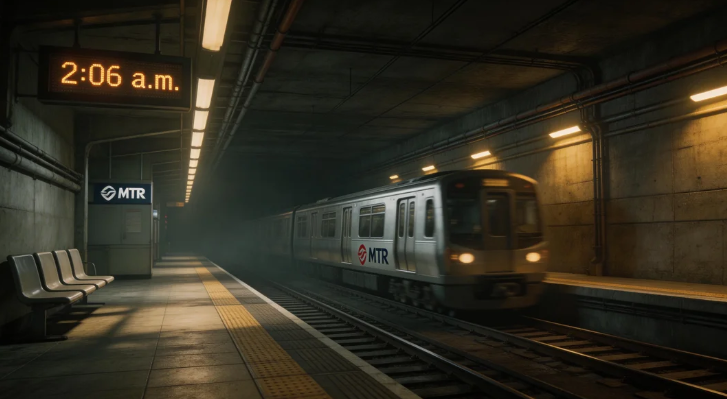
Ethan, a Canadian ink-artist, flew to Hong Kong to trace the lost hand-tap tebori style rumored to survive in Kowloon’s underground malls. At 2:06 a.m.—the hour when the MTR’s last train ghosts through the tunnel without passengers—he found a shuttered kiosk wedged between a closed bubble-tea stand and a mah-jong parlor. A single neon character flickered: 墨 (ink), its loop cracked so it resembled 鬼 (ghost).
Inside, an elderly woman in a cheongsam the color of funeral joss paper greeted him without looking up. Her right arm was covered by a sliding sleeve of glass beads; beneath, Ethan glimpsed a scarlet Qilin whose eyes blinked independently. “Nine strokes only,” she said, tapping a bamboo stick that dripped ink the shade of dried ox-blood. “After that, the needle chooses the skin.”
Ethan asked for a small foo-dog on his shoulder. Instead, the woman traced a single continuous line that looped into the outline of Kowloon Station itself—platforms, exits, even the broken escalator that had been out of service since 2019. With each tap, the ink felt cold, as though the pigment were subway wind compressed into liquid. On the ninth stroke, the Qilin on her arm leapt—Ethan felt its hooves land on his fresh tattoo, dragging the station map deeper, beneath skin, into fascia.
The lights blacked out. Through the kiosk’s grated door he saw the concourse now mirrored on his forearm: LED boards scrolling “Last Train 00:00,” though real time was past 2 a.m. A train whooshed by without sound; its windows showed passengers with no faces, only QR codes where features should be. One code matched the serial on Ethan’s Octopus card—still tucked in his pocket, but now warm, pulsing like a second heart.
He tried to stand, but the station map on his arm rearranged itself: Exit C became Exit 冥 (underworld), and the purple Tsuen Wan line extended into a vein that entered his cubital fossa. The old woman whispered, “When the map beats, board the train.” She rolled down her bead sleeve; the Qilin was gone, leaving an empty scarlet outline that leaked cinnabar smoke.
Ethan sprinted into the concourse. The turnstiles opened without tapping. On Platform 4, a train painted funeral-white waited, doors sighing like burnt paper. Inside, every hand strap was a noose of knotted red string. He felt the vein-line on his arm throb—once, twice—matching the door chime. At the third throb, his feet lifted; the Qilin’s silhouette re-appeared beneath the fluorescent floor, galloping in reverse, dragging Ethan’s reflection into the rails.
He remembered childhood lore: spirits can’t cross copper. Frantically, he scraped the copper rivet from his jeans pocket—the one he used to stretch canvases—and pressed it against the vein-map. The line scorched, curling like plastic. The train doors slammed; lights imploded to a single red dot—the Qilin’s eye—before the entire carriage folded into a paper ticket that fluttered to the platform.
Ethan stumbled back into the mall. The kiosk was shuttered, neon sign dark, as if untouched for years. His arm now bore only a faint white scar shaped like Kowloon Station—no ink, no vein. But at 2:06 a.m. every night since, no matter which city he sleeps in, he wakes to hear distant MTR chimes counting down three beats, while under his skin something gallops toward the next station—one that has never appeared on any map.